The 3 most common ways carbon credit suppliers and buyers meet:
They’re long-time acquaintances and met in previous roles
At conferences
They’re introduced by a mutual acquaintance (non broker)
The voluntary carbon market trades on relationships. That perhaps isn’t surprising in a small market, but it does make it hard for newer and smaller project developers to break in, regardless of the quality or price of their product.
This data is from a report I got to work on with Ecosystem Marketplace earlier this year.
We ran a survey with 48 carbon credit suppliers (including project developers, traders, and marketplaces). Enormous thank you to everyone who responded to the survey!
A few years ago, I began keeping a private spreadsheet of companies that have internal carbon fees. Carbon fees are an elegant and logical way to create a budget for corporate climate action, and an excellent example of putting a real price on carbon. So, I’m always inspired by, and curious about, companies that successfully use them––How do they structure the fee? What does it apply to? And how much is it?
I began sharing this spreadsheet publicly in 2025 and I’ve now published an updated (and much expanded) 2026 edition. You can access it here:
What are carbon fees?
Carbon fees are a real charge companies levy across business units per tonne of CO2e emissions. They’re a type of internal carbon pricing that uniquely involves collecting an actual fee per tonne of emissions.
Carbon fees incentivize emissions reductions, increase transparency into the climate impact of business operations, and create a straightforward climate action budget, directly linked to ongoing emissions.
Here are a few insights from this year’s carbon fee tracker:
1. Fees on employee travel average $88/tonne CO2e
Employee travel may be the easiest place to start with an internal carbon fee. The data is pretty clean and easy to get. And the fee immediately opens up a great line of communication across the company on the climate impact of business operations.
Many of the biggest companies using internal carbon fees started just with a fee on travel, and expand the levy from there.
2. Tech firms’ internal carbon fees average $118/tonne CO2e
Tech firms use the highest average fees per tonne. They’re followed closely by financial services firms (avg $90/tonne), another sector with high profit:emissions ratios.
3. 2026 saw a big spike in carbon fee adoption from consumer-facing brands
The non-profit The Change Climate Project launched The Climate Label in Jan 2025. The certification requires participants not only to make steady emissions reductions, but also adopt a ≥$15/tonne internal carbon fee. Over 190 companies––mostly small and mid-sized B2C brands––certified under the label in 2025.
You can read more about carbon fees and see the full list of >220 companies using them in Carbon Capital Lab’s latest report, here.
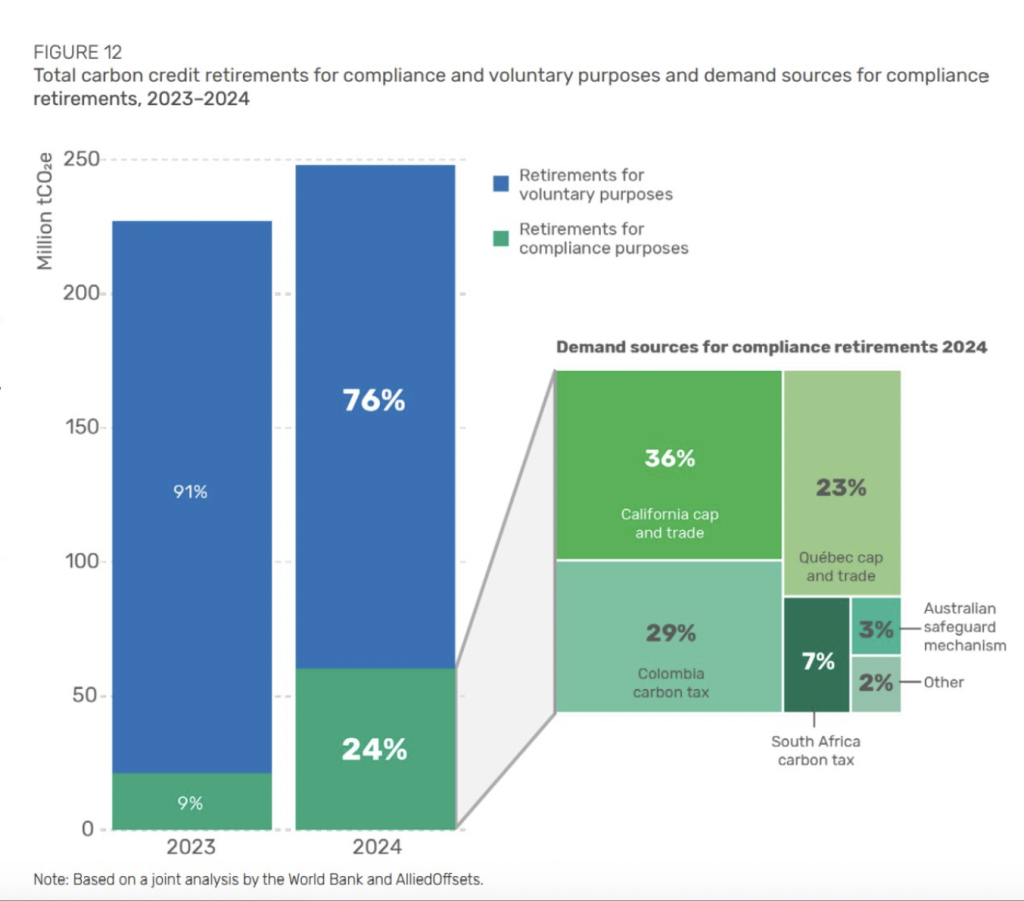
Roughly 1-in-4 carbon credits retired in 2024 were used toward a compliance carbon pricing obligation. The California/Québec cap-and-trade system is the largest compliance-driven source of demand for carbon credits from independent standards.
While third-party ratings are growing in popularity as a tool to help guide buyers through the complexity of the voluntary carbon market, the continued growth of carbon credit retirements toward compliance schemes raises an interesting question:
Do we need carbon project ratings in compliance carbon pricing schemes?
If these policies do a good job of laying out the criteria for credits that meet the program requirements, then why differentiate projects further with ratings?
I’ve heard two views on this:
1. Clear regulations should make project ratings superfluous. A compliance carbon pricing scheme should treat eligibility as a binary determination––either a credit counts toward the scheme or it doesn’t.
This reduces complexity for buyers by making the definition of an eligible carbon credit very clear. And this confidence in the rules (and therefore in future demand) will unlock speed and scale in finance.
2. Even with clear rules, there will still be a range of quality in carbon projects and buyers will want insight into this. Ratings will function something like bond market ratings, giving buyers insight into the likelihood of a carbon project’s effectiveness. In addition, buyers may want to stand out from their competitors by paying a premium for quality.
BeZero data shows a wide variety of ratings for carbon projects that are CORSIA-eligible. It’s not so different from the ratings spread of projects across the VCM, with 65% of eligible credits rated B or lower on the BeZero scale.
I am partial to the first view. Reducing complexity in carbon markets will help unlock climate finance, so, I’d rather focus on getting the policy rules right, with the aim of eliminating the need of additional project ratings.
I’m not totally clear on how the EM survey defined a buyer ‘inquiry,’ so it’s tough to tell how qualified the inquiries were. Regardless, I tried to get a sense of how this compares with other industries –
In-person car sales: 20-30% of showroom traffic ends in a sale;
Internet car sales: 10-15% of internet leads result in a car sale (so about 2x the carbon credit deal rate)
Carbon credit sales close rates are much higher than all of these. There’s a lot of friction in the carbon credit sales cycle. Reducing this sales friction would save a lot of people time and accelerate climate finance deployment.
In other capital intensive industries, offtake agreements help fix this problem. These agreements provide future demand certainty, giving investors confidence to step in and finance a project that can meet that demand.
So far, the data shows this may be working for carbon projects too – at least when it comes to nature-based projects:
Among survey respondents, project-level debt was rare, with just 13% of projects relying on it as their primary source of funding (this was actually a lot higher than I thought it would be).
But of projects that did have access to project-level debt, 85% had a signed offtake agreement.
The data doesn’t prove causation—that the offtake was the reason the project developer could access project-level debt—but it shows a very strong correlation between the two.
What kind of carbon credits do new buyers purchase?
In 2025, first-time carbon buyers based in Asia and Europe accounted for the largest purchase volumes among new buyers.
These new buyers had unique project type preferences, according to data from AlliedOffsets. The chart below shows what types of credits they purchased or signed offtakes for; the thickness of the bars represents credit volumes (not number of buyers).
Source: AlliedOffsets, VCM 2025 Review, pg 27
Carbon project demand from new buyers by buyer location:
Asia – NBS
First-time buyers based in Asia overwhelmingly purchased credits from land-based project types (including nature-based projects and BECCS). This may have been driven by a few large nature-based carbon removal offtakes announced in early 2025.
Europe – Renewable Energy and BECCS
Nearly two-thirds of carbon purchases from European-based first-time carbon buyers were from renewable energy projects. European-based new buyers also purchased carbon credits from BECCS projects, as well as a basket of other project types.
N America – Renewable Energy and Agriculture
In 2025, first-time buyers based in North America made relatively small purchases compared to their counterparts in Asia and Europe.
About half of purchases from these new buyers were from renewable energy projects.
N. America-based new buyers were also more likely to purchase credits from agriculture projects than new buyers in other regions.
This report dives into how nature-based carbon project developers around the globe are funding their projects, structuring offtake agreements, and where they’re running into the biggest hurdles accessing project finance. It’s based on a survey of 74 NBS project developers.
Four findings from the research:
1. The majority of projects rely on organization-level funds or project-level equity
Survey respondents most commonly relied on organization-level funding, including a founder loan and company-level equity, to cover project expenses. About one quarter of projects had access to project-level equity.
2. The cost of capital alongside the cost of getting ‘investment-ready’ were top obstacles to accessing finance
Respondents cited the cost of getting a project past milestones most financiers and funders require, coupled with lengthy investor and offtaker due diligence timelines, as their top obstacle to accessing funding. The high cost of capital was the top source of overall project cost uncertainty as well as another major bottleneck to accessing finance.
3. Projects with an offtake were 6.7x more likely to utilize project-level debt
Project-level debt was rare—just 13 percent of projects utilized this as their primary funding source. Of these, 85 percent had a signed offtake or were in late-stage negotiations for one.
4. Philanthropic capital was scarce, and primarily for new developers with early-stage projects
Just 9 percent of projects utilized grants or philanthropic capital as their primary funding source. This funding was almost entirely used by projects that were very early-stage (pre-PDD) and developers who had never previously sold credits.
Here’s what SBTi’s new net zero draft says about mitigating ongoing emissions (and carbon credits):
SBTi’s net zero standard (v1) has had no requirement for companies to take responsibility for the emissions they’ll continue to emit on the decades-long path to net zero. They’re meant to ratchet these down over time, but there’s been little clear incentive to mitigate what’s left each year.
Given the time value of climate action – any ton of CO2 emissions we avoid today is worth a lot more than a ton we avoid tomorrow – this has been a major miss for the climate.
Today, SBTi released a new draft of its v2.0 net zero standard. Nothing is finalized and there’s more consultation to come. But this is the first draft to propose stronger incentives – and eventually requirements – for companies to take responsibility for ongoing emissions.
Here’s what’s proposed:
1. 2028 – 2035 – clear recognition for taking action on ongoing emissions Nothing would be mandatory between now and 2035. But the new draft sets out two tiers of recognition for companies if they voluntarily mitigate some of their ongoing emissions. These tiers are:
A. Recognized – companies that mitigate at least 1% of their ongoing emissions across Scopes 1-3; They can do so through either of the following: – Apply a carbon price to at least 1% of ongoing emissions and use that budget to support eligible climate action; recommended this be at least $20/ton; OR – Mitigate at least 1% of ongoing Scopes 1-3 emissions via approved, quantified mitigation outcomes expressed in tons CO2e (eg retirement of carbon credits)
B. Leadership – for companies that mitigate 100% of their ongoing emissions across Scopes 1-3. They must do BOTH of the following: – Apply a carbon price to 100% of ongoing emissions; at least $80/ton, AND – Use that budget to mitigate at least 40% of ongoing emissions via approved, quantified mitigation outcomes expressed in tons CO2e (eg retirement of carbon credits).
2. 2035 – net zero year (eg 2050) Starting in 2035, the standard will require action on ongoing emissions. How much and what counts probably won’t be defined until closer to 2035.
3. Net zero year and onward (this part isn’t new) This is where the ‘residual emissions’ rules kick in – these aren’t new. Depending on the sector, companies may have up to 10% of ‘residual emissions’ – those for which there is no carbon-free alternative. From their net zero year and onward, companies must neutralize these residual emissions each year via carbon removal (likely tech-based CDR). What kinds of carbon credits would count? It looks like both removals and reductions could count! More on this later.
Note: the notes above are relevant to Category A companies – those that are larger and based in high-income countries. The proposed rules for Cat B companeis are slightly different.
Three charts showing the growing price premium for high-quality NBS carbon credits.
1. $10/ton growth in 2025 for highly-rated ARR credits
Average prices for afforestation and reforestation (ARR) credits rated BBB or above by Sylvera rose to $24/ton in September. That’s up $10 since January of this year.
2. >40% premium for highly-rated NBS credits across project types
Calyx Global data shows a very large price premium for nature-based carbon credits in its Tier 1 category (A-rating or above on the Calyx scale). Calyx/Clear Blue Markets pricing data for Tier 1 NBS projects began in May, 2024 and showed about a 40% premium over Tier 2 credits at that time. The chart shows this Tier 1 premium rising steadily since then, to about ~150% as of July of this year. This data is across all nature-based project types rated by Calyx, so includes both removals and reduction/avoidance projects.
The third chart, this one by AlliedOffsets, shows a very large spread between maximum estimated retired price for NBS credits vs weighted average, since Jan 2024. Though the chart isn’t mapping this against a measure of project quality, it underscores the story in the previous two charts – that a few projects are selling for substantial premiums above average market prices.
It’s impressive to see the correlation between high ratings and price premiums. To me, it’s unclear whether the ratings are causing the price premiums, or just reflecting what’s happening (probably a little bit of both?). Either way, it underscores the big responsibility on ratings agencies to get it right !
Some ARR credits may now count towards Singapore’s carbon tax.
For now, this may only be VM0047 projects in Ghana. But, the pool of eligible reforestation projects could grow in the coming year.
Background:
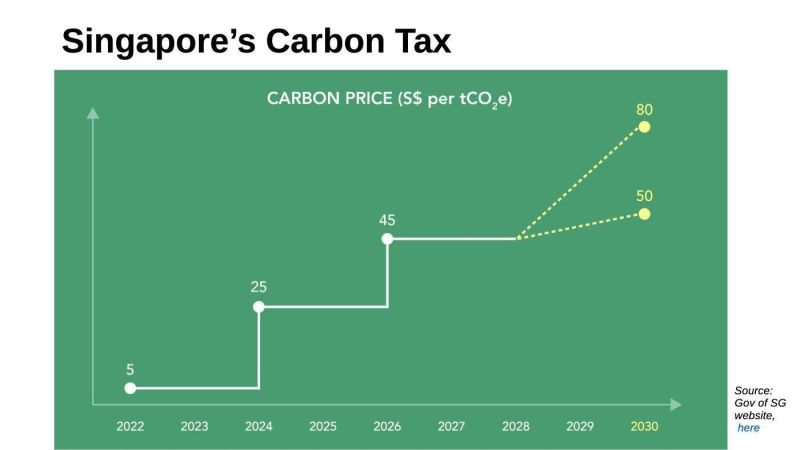
Singapore has a carbon tax scheme covering about 70% of its emissions. Companies subject to the tax can satisfy up to 5% of their obligation using international carbon credits that meet specific criteria, including:
1. Location:
Projects have to be in a host country with which SG has a bilateral agreement. Currently 9 countries that have agreements with SG: Bhutan, Chile, Ghana, Papua New Guinea, Peru, Paraguay, Rwanda, Thailand, and Vietnam
2. Vintage:
Between 1 January 2021 and 31 December 2030.
3. Approved registry and methodology:
🔗 to list of approved methodologies by registry and country in comments; note that approved methodologies varies by host country.
Verra’s afforestation/reforestation methodology (VM0047) is not on the list of approved project methodologies that can satisfy the tax.
But, that just changed.
What’s new:
Earlier this month, the government of Singapore signed contracts for over 2 million carbon credits from four nature-based carbon projects to help the country meet its Paris Agreement NDC. The projects include:
One VM0042 (soil carbon emission reductions and removals) project in Paraguay
One VM0047 project (afforestation/reforestation methodology), in Ghana, and – 2 VM0048 (REDD+ methodology) projects, in Peru.
While VM0042 was already on the list of approved methodologies for generating credits that count toward the tax, VM0047 and VM0048 were not. This announcement likely means these methodologies will soon be whitelisted for the host countries where the projects are located (see sources 2 and 3 in comments).
Which methodologies count varies by country. For now, I’d only expect VM0047 credits from projects in Ghana (which also meet the Republic’s additional criteria) to count toward the tax. But this announcement opens the door for more VM0047 projects from other host countries counting towards Singapore’s carbon tax in the future. Stay tuned!
— Image from SG’s National Climate Change Secretariat
Who is the ideal investor for an early-stage NBS carbon project?
Many nature-based carbon project developers bootstrap the first $500-$1M in project costs to get through a feasibility study, or rely on grants and philanthropic funding to cover those early costs. That money can be hard to access and slow.
If we want to launch a lot more high-quality NBS projects, where could more very early capital come from?
Here’s the list I’ve been keeping of investor (or funder) attributes that would make a good match for very early-stage nature-based carbon projects:
Fast and flexible: Due diligence expectations have to fit the level of project maturity. While making sure a project has some path to financial stability is important, putting an early-stage, lean team through a due diligence process more appropriate for a mature infrastructure developer can be so costly that it can kill a project. Early money has to move fast and be flexible.
Comfortable with (high) risk: It’s a long road from pre-feasibility to a large-scale NBS project consistently issuing credits. Some projects ultimately won’t be a good fit for carbon finance. Investors who come in at the very early-stage have to understand this.
Patient: Nature’s timelines don’t match investors’ typical timelines. NBS projects take years to develop and begin issuing credits in volume. The best early-stage investors will be patient.
Friendly (or concessional): At current VCM prices, I believe few NBS carbon projects can provide market-rate returns; certainly not at the rate that an investor coming in early, and therefore taking on a lot of risk, might normally expect. Do we need investors who are willing to take below market-rate returns, and if so, who are they?
My read is that few impact investment funds are willing to take a hit on returns, and DFIs rarely satisfy criteria #1.
(One caveat here may be projects with revenue streams in addition to carbon – that’s a whole other discussion though.)
I’m curious if the above aligns with what others see in this space?
What other investor attributes would you add to the list? And, perhaps most important, what kind of investors fit that description?
I look at the list and wonder:
Does very early-stage capital to develop a NBS carbon project need to be philanthropic or “venture philanthropy”? At least until the market gets more comfortable with how NBS carbon projects work? Are there learnings from early days in renewable energy that can apply here?
Only about 70% of carbon credits committed in offtake announcements had disclosed project types.
Of offtakes that disclosed project types, nearly 90% of contracted tons were from removal projects.
Of those, ~2.6x more nature-based removal credits were secured than tech-based CDR tons.
Three caveats to note:
The chart only shows announced offtake agreements. It’s possible (likely, even) there are offtakes happening for which there have been no public announcements.
I believe the chart uses a broad definition of ‘offtake,’ including both signed agreements to buy from specific project developers, and more general commitments to buy, which will be translated into offtakes in the future.
Commitments to buy include things like the Microsoft & Rubicon Carbon 18M ton agreement to purchase ARR removal credits. That commitment will be translated into a series of 15-20yr offtakes in the future. I believe it’s included in the green NBS removals category in the chart.
The maroon bar shows 30M tons contracted for which there was no project type disclosed.
Depending on how those break down across project types (roughly in same split as for the announced project types? or more heavily weighted toward a single project type?), the overall project breakdown could sway a bit.
I’m estimating the split of those 30M tons isn’t wildly different from that of offtakes that disclosed project types (if I had to guess, my hunch is it may lean slightly more toward tech-based CDR, but not dramatically so).
The non-profit recently launched a revolving fund. The fund uses philanthropic capital to make pre-purchases of carbon removal credits from project developers across a range of removal pathways.
Once the credits are delivered, Terraset will re-sell the credits to other buyers and then plow the money back in to fund more pre-purchases from early-stage projects.
This model could create a highly catalytic, evergreen fund to accelerate carbon removal scale up.
(Currently only 15M credits exist that fully meet Phase 1 requirements)
In a more optimistic supply analysis, there could be as many as 176M CORSIA-eligible credits available to meet Phase 1 demand. In that case, supply would be available (assuming no demand from buyers not subject to CORSIA), but very tight.
Without enough credits on the market to meet CORSIA Phase 1 requirements, there’s a big risk that airlines won’t comply, countries will be hard-pressed to enforce the program with penalties, and the whole program will lose credibility.
The biggest factors limiting CORSIA-eligible supply are:
The CORSIA technical advisory body (TAB) has approved credits from a limited set of registries, methodologies, and vintage years for inclusion in the program;
Of carbon projects that meet the TAB’s registry+methodology requirements, most are early stage and the credits haven’t yet been issued. So, a lot needs to go right for these projects in the next 2 years for their credits reach the market in time; and
The biggest factor limiting CORSIA Phase 1 credit supply is that few countries are yet set up to issue corresponding adjustments (CAs), which are a requirement for all CORSIA-eligible credits.
Source: State and Trends of Carbon Pricing, 2025, World Bank
2024 may have seen an unusual spike in carbon credit retirements to satisfy compliance carbon pricing programs since it was the end of a 3-year compliance period cycle for the California and Quebec ETSs. Fifty-nine percent of credits retired in 2024 for compliance purposes were used to satisfy obligations for one of these two programs. As a result, we may not seem the same level of retirements for compliance reasons in 2025.
But overall, carbon credits are playing a growing role in compliance carbon pricing schemes.
40% of government-run carbon pricing programs around the world permit some use of credits to meet their obligations. And, several of these programs are increasing the portion of the tax obligation that companies can meet with credits.